You didn't quit your habit app because you're lazy
Day 23. It was going well. Then your kid got sick, or a deadline moved, or you fell asleep on the sofa at nine with your shoes still on. Next morning the app greets you with a big, clean 0.
You don't decide to quit. You just stop opening it, the way you stop stepping on the scale after Christmas. A few weeks later your phone asks for storage, you delete the thing, and it joins the pile of stuff you were going to be better at.
Most people blame themselves for that. The research mostly blames the setup, which is good news, because the setup takes about ten minutes to change.
The zero hurts more than the missed day
In the best-known study on habit formation, a team at University College London followed 96 people as they tried to build a new daily habit over 12 weeks. Missing a single day made no significant difference to how the habit developed.
Your app treats that same day as a disaster.
Marketing researchers Jackie Silverman and Alixandra Barasch tested what that does to people across seven studies, published in 2023. People who saw a broken streak on screen engaged less afterwards, even when what they'd actually done matched people whose streak looked intact. The drop got bigger when people blamed themselves for the break, and smaller when the streak could be repaired.
So picture two people with an identical week and one identical missed day. The one whose screen says 0 is the one more likely to give up.
Your reminder is doing the remembering for you
Now the awkward part for anyone who builds these apps, us included.
A UCL team reviewed 115 habit apps and ran a four-week study with real users, published at the CHI conference in 2015. Reminders did get people to repeat the behaviour. They also seemed to get in the way of it becoming automatic, because people leaned on the ping. Tying the habit to something already happening in their day worked better for that. Positive reinforcement, the little well-done moments, made no measurable difference.
That would explain a very specific experience. You floss for six weeks on a 9 p.m. notification, your phone dies on holiday, and the habit vanishes as if it had never existed.
Forget 21 days. Forget 66 as well.
You've probably heard a habit takes 21 days. In the UCL study the median was 66, and the range ran from 18 to 254. Phillippa Lally, who led it, has said 66 shouldn't be treated as a rule either.
A glass of water after breakfast and a 6 a.m. run were never going to take the same time. Any app promising a new you by the end of the month is guessing.
One catch, in fairness. A missed day is fine, but turning up now and then isn't: the least consistent people in that study didn't form the habit at all.
A setup that can survive a bad week
None of this needs a new app. You can do it in whatever you've got, including a pen.
Start with one habit
On the first night you'll want five. Everyone does. You feel like a new person and the app has a nice plus button. Five habits means five failures to look at on a bad day, so pick the one that would make everything else easier if it stuck, and leave the others in a note for next month.
Write the trigger as a sentence
After I pour my first coffee, I take my vitamins. After I plug my phone in at night, I put out my gym clothes. The first half has to be something that already happens without your help. “In the morning” doesn't count, because morning is a vague region of the day and nothing actually happens in it to remind you.
Psychologists call these if-then plans. A 2006 review of 94 tests found they help people follow through, though later re-analyses suggest the effect is smaller than that first estimate. We'd still take a modest effect that costs one sentence.
Decide now what the worst-day version is
Ten push-ups becomes one. A chapter becomes opening the book. A half-hour walk becomes going outside and standing there for a minute, feeling slightly ridiculous. Write it down today, because on the bad day you won't negotiate fairly with yourself.
Move the reminder later
Keep it, but demote it. If the habit hangs off your morning coffee, set the ping for 9 p.m. and let it ask whether it happened. Most days you'll have done it already, and the ping only catches the odd miss. That's our reading of the UCL findings, by the way, and nobody tested this exact trick.
Count the month, not the streak
Twenty-two days out of thirty is a habit taking shape. A streak counter could look at that same month and tell you “current streak: 3”. Once a month, add up the total and look at that number instead.
Three people, three ways of losing a habit
Jonas and the six new habits
Jonas downloads a tracker on New Year’s Eve, with a drink in his hand and great plans. Gym, water, reading, meditation, no sugar, Spanish. By 9 January he’s doing water and feeling terrible about the other five, and by the 20th he has stopped opening the app, because he knows what it’ll show him. In February he tries again with one: a glass of water after he puts the kettle on. In March he adds ten minutes of Spanish on the train. A year later that’s still two habits. Six would have made a better story, and two is what he has.
Elif and day 140
Elif’s meditation streak was the thing she was proudest of, and it had got to the point where she’d sit on hotel beds at midnight doing it for the number. Then her father went into hospital, and ten days later she noticed she hadn’t opened the app. The screen said 0. She didn’t meditate again for five months. When she came back she turned off the counter and went by “how many days this month”. She has missed plenty since, and the only thing that has happened is that she’s meditating.
Marta and the 9 p.m. ping
Marta flossed every night for six weeks, then went on holiday with a dead charger. When she got home the habit had gone, as if someone had cleared it. Looking back, she’d never been flossing after brushing her teeth. She’d been flossing after her phone told her to. The fix cost nothing: the floss moved to sit on top of her toothbrush, and the reminder moved to 10:30, as a last-chance check she rarely needs.
So do habit apps work for adults with busy lives?
They can, if you give them the right job. An app is good at showing you a pattern you can't see from inside your own week, and at catching the day you forgot. It can't supply the cue, and a streak won't carry you through a month when your life's on fire.
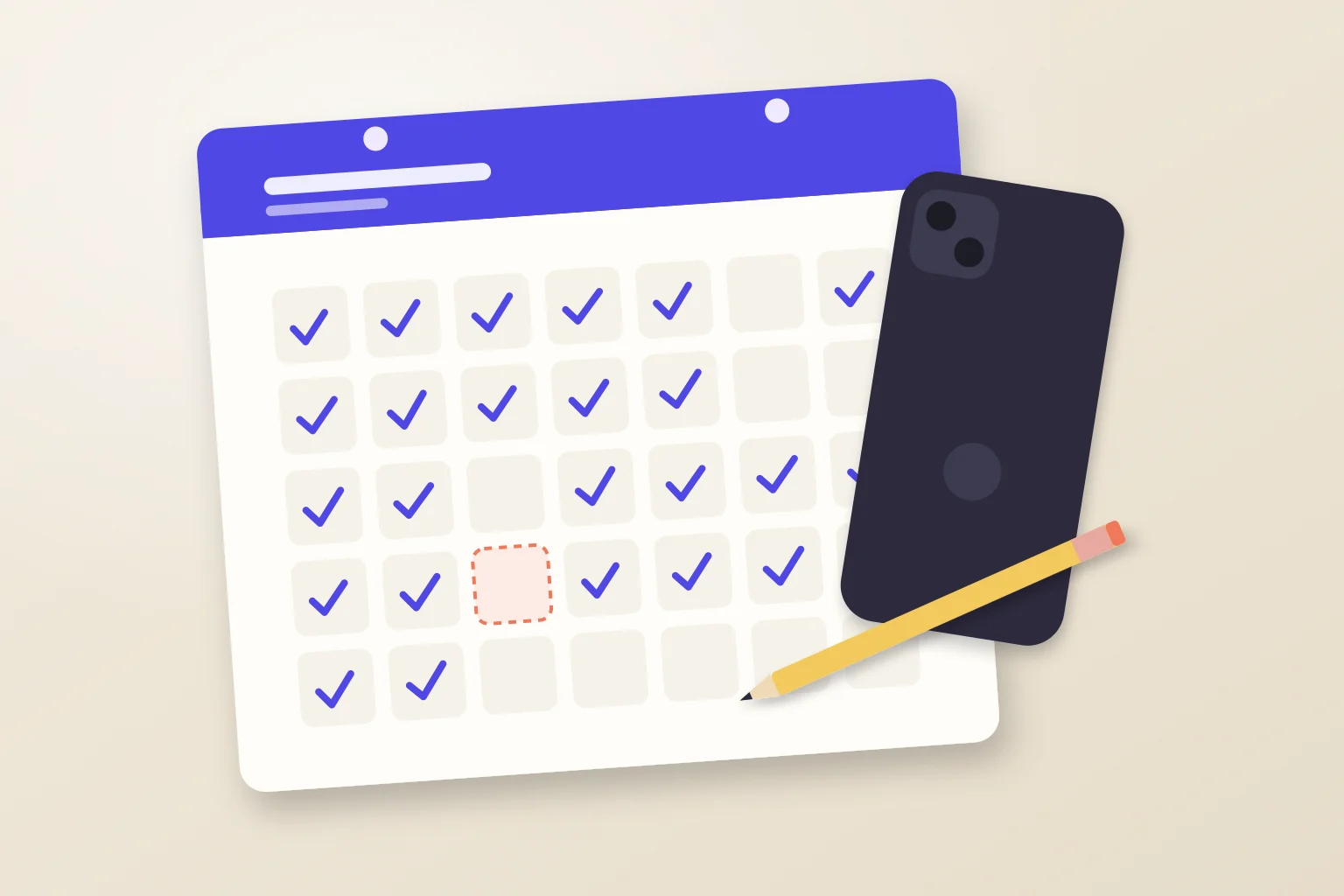
If your schedule changes constantly, hang habits on things that survive it: waking up, brushing your teeth, plugging in your phone. A habit pinned to 7 a.m. won't last one business trip. And if you'd really look at a wall calendar with a pencil tied to it, that's a perfectly good tracker.
How to come back after you’ve dropped it
- 1.Don’t decide anything about yourself today. Delete the app if you like, but leave your character out of it.
- 2.Ask what stopped it. An illness, a new job or a holiday may have knocked out the moment you tied it to. That’s a logistics problem.
- 3.Run the worst-day version for a week, even if you feel fine.
- 4.Ignore the counter. Look at the total, or hide the streak if your app lets you.
- 5.If you find you don’t care about the habit any more, let it go. You’re allowed to change your mind.
Missed a week, or a month?
A full guide to restarting without another Monday reset.
Questions people ask about habit apps
Why do I lose motivation after a few weeks?
Early on you’re running on novelty, and that fades. A habit only gets easier once the cue does the work, and going by the UCL study that can take a couple of months or more. So the dip comes when it’s still hard and no longer exciting. Expect it, make the habit smaller for a while and keep going.
Are streaks bad for you?
Not always. Plenty of people like them, and a streak can be a fun reason to show up on an average day. The trouble comes when it breaks. In Silverman and Barasch’s studies, people engaged less after a visible break, and less still when they blamed themselves. If a streak starts to feel like something you’re protecting, count the month instead.
Is there a habit tracker without streaks?
Yes. Some trackers hide them or let you skip days, and a paper calendar has never shown anybody a 0. Check how an app treats a missed day before you commit. Can you tick a past day? Does your history survive?
Comparing habit trackers?
Six side by side, including the free ones.
Should I use a habit app at all?
If you’re not sure, try without one first. The app isn’t what builds the habit. If you want reminders, a record you can look back on and your habits next to your tasks, it can help. If opening it makes you feel bad, it’s doing more harm than a pencil would.
How long should I give a new habit?
A few months before you judge it. The median in the UCL study was 66 days, with a range from 18 to 254, and a 2023 study found that gym habits typically took months while hospital handwashing took weeks. At the end of each month, check whether it’s getting easier.
Yes, we make one of these
DayriOS has a habit tracker, and it has streaks, because plenty of people like them. We haven't solved everything above, and you should be suspicious of anyone who says they have.
What we can point to: there's a 7-day strip where you can tick past days, so a day you did the thing and forgot to log doesn't wipe your streak. (Yes, you could cheat. It's your streak.) Your total completions sit next to it, so one break doesn't make your whole history look like nothing. You get a reminder per habit at whatever time you pick, including the late safety-net kind. And habits live beside your tasks and goals, so you're not keeping yet another app alive.
The free plan has five habits, which is four more than this article wants you to start with.
Tonight, before you close this tab, write one line: “After I ___, I will ___.” Then write the worst-day version next to it. The back of a receipt is fine.
See how habits work in DayriOS
Free to start: five habits, reminders and streaks you can repair.
Sources
- Lally et al. (2010), European Journal of Social Psychology
- Does it really take 66 days to form a habit? Interview with Dr Pippa Lally, University of Surrey
- Silverman & Barasch (2023), Journal of Consumer Research
- Stawarz, Cox & Blandford (2015), Beyond Self-Tracking and Reminders, CHI
- Gollwitzer & Sheeran (2006), implementation intentions meta-analysis
- Buyalskaya et al. (2023), PNAS