Your morning routine lasted four days. Build one for your worst morning
Monday: up at six, water with lemon, ten minutes of journaling, a walk. You feel like a person in an advert. Thursday: you slept badly, one shoe is missing, and the whole thing is gone by 7:15. By Sunday you’ve stopped mentioning it.
Most routines are designed on a good day, by someone with energy, for someone who won’t have any. So design yours for that other person.
Why routines fall apart by Thursday
A routine usually dies in one of a few predictable ways, and it helps to know which one killed yours.
- •It was copied from someone else’s life. Their morning has a quiet house, a home gym and a later school run than yours.
- •It’s all or nothing. The plan says 40 minutes, you have 12, so you do none of it, and doing none of it makes tomorrow’s attempt feel pointless.
- •It runs on a clock. “6:30, stretch” falls over the first time the alarm doesn’t go off or the night shift runs late.
- •It has too many decisions in it. What to wear, what to eat and which workout are all being decided by someone who woke up four minutes ago.
- •It isn’t for anything. If you can’t say what the routine is supposed to give you, the first bad morning will win the argument.
That last one deserves a minute. A calmer start with the kids? Thirty minutes of real work before email? Feeling less like a zombie by ten? Pick one, and you’ll know what to keep when you have to cut things.
How long this really takes
You’ve heard 21 days. In the best-known study, Phillippa Lally’s team at University College London followed 96 people as they built one daily behaviour. The median time for it to feel automatic was 66 days and the range ran from 18 to 254. Missing a single day made no significant difference.
A 2023 paper in PNAS used machine learning on over 12 million gym observations and over 40 million hospital handwashing observations. The gym habit typically took months to form. Handwashing took weeks. The authors found no magic number, so give your routine a few months before you judge it.
Build it in three sizes
Write your routine three times.
- •Normal: an ordinary day. Twenty minutes, say. Stretch, shower, look at today’s three things.
- •Bad day: two minutes. One stretch, and read your three things while the kettle boils.
- •Ill or travelling: one thing, whichever matters most to you. A glass of water and a look at the calendar will do.
The bad-day version does the heavy lifting, because it keeps the sequence alive when the full one is impossible. That’s our reasoning, and nobody has run a trial of it. The research does give a warning: a missed day was fine in Lally’s study, but the least consistent people didn’t form the habit at all.
Hang each step on something that already happens
A clock time is easy to sail past. “After I put the kettle on” is harder to miss, since the kettle goes on regardless. In their 2012 summary for family doctors, Benjamin Gardner, Lally and Jane Wardle describe habit formation as repeating an action in a consistent context, and Gollwitzer and Sheeran’s meta-analysis of 94 tests found that if-then plans help people follow through.
Write each step in this form: after [thing that already happens], I [small step].
- •After I put the kettle on, I stretch.
- •After I sit down at my desk, I write today’s three things.
- •After I brush my teeth at night, I put my phone on the charger outside the bedroom.
Keep the chain short
Each extra step is another chance to lose the thread. Start with two or three. Add one more only when the others run without you thinking about them. The twelve-step morning from that video belongs to someone who has a video crew and no school run.
Half of your morning happens the night before
Two minutes in the evening can take a lot of deciding out of the morning. Put out your clothes. Write down the first thing you’ll do tomorrow. Leave the mug next to the kettle. You’re doing your tired future self a small favour, and that person will take it.
Three routines from three very different lives
Sara, nurse on rotating shifts: no two days start at the same time
Every routine Sara finds online begins with a time, and she sometimes wakes up at 5 a.m. and sometimes at 2 p.m. So hers has no clock in it. After I wake up, whenever that is, I drink a glass of water. After the water, I open the curtains and look at the one thing that has to happen today. After a shift, before the sofa, I put my uniform in the wash.
Her normal version adds ten minutes of stretching. Her bad-day version, which after three night shifts in a row is most days, is the water. It’s a short list, and it has survived a rota that changes every month.
Ben, single dad of a six-year-old: 7:15 is a crime scene
Ben’s old plan was to get up at six and have an hour to himself. He managed it twice. Now most of his routine happens the night before: lunchbox packed, school bag by the door, shoes actually found. In the morning he has one thing of his own, which is two minutes in the parked car after drop-off, engine off, looking at his three things for the day before he drives to work.
On the bad-day version he skips the three things and just sits there breathing for a bit. By the standards of the internet it isn’t much of a morning routine, and it’s the first one he has kept past a fortnight.
Yuki, works from home: the day has no edges
Yuki’s commute is eleven steps, so nothing separates waking up from working, and by 9 a.m. she’s answering email in bed. She gives herself a fake commute: after coffee she walks around the block, and when she’s back at the door, the workday has started. At six she does the same walk the other way round, and the laptop stays shut after that.
It takes ten minutes each way. In the rain, the bad-day version is standing on the balcony for a minute in a coat, feeling like an idiot. She does it anyway.
Track it, lightly
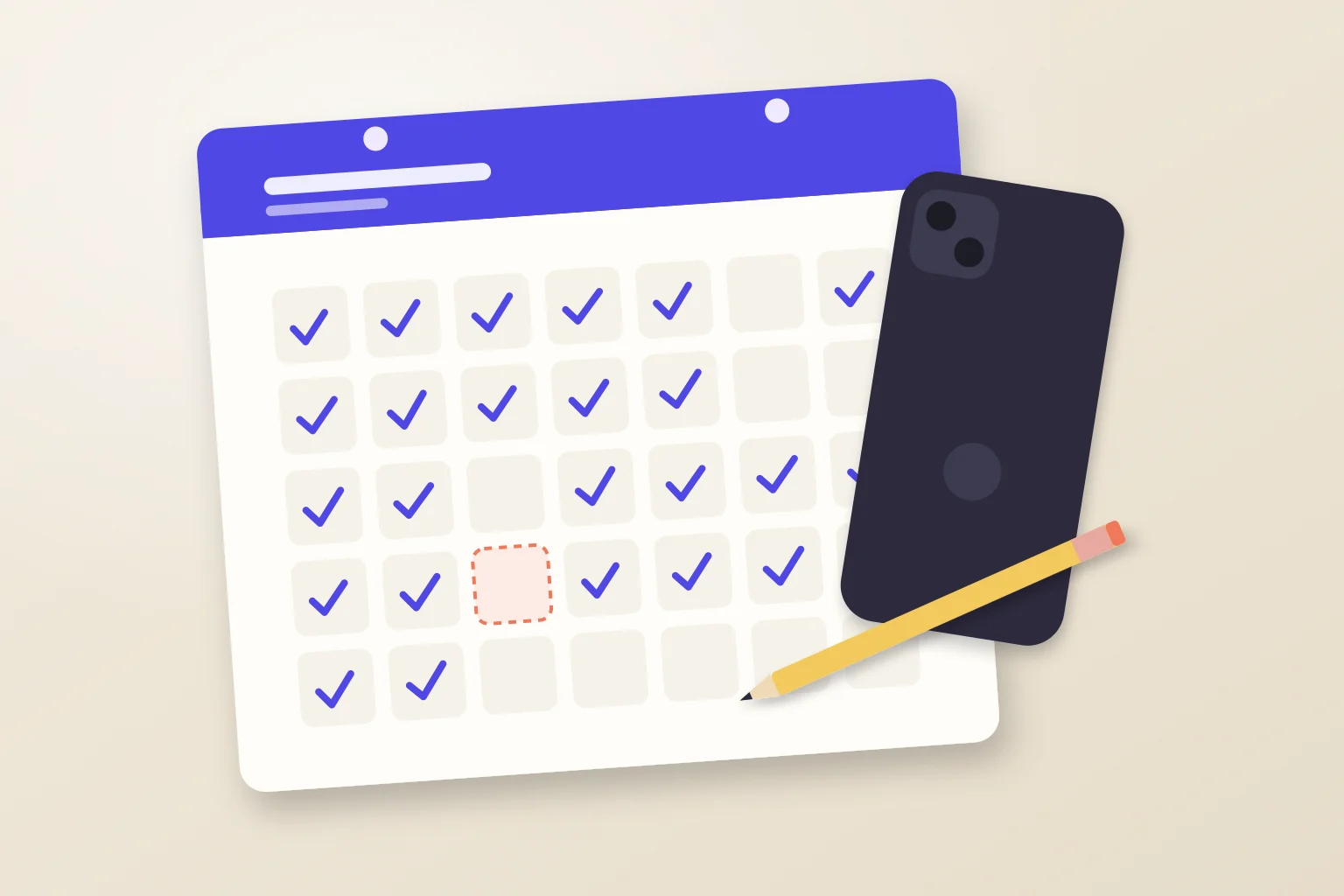
A meta-analysis of 138 studies with nearly 20,000 people found that monitoring progress helped people reach their goals, and it helped more when the progress was physically recorded or shared with someone. So a tick on a paper calendar counts. Look at the month rather than the streak: 22 mornings out of 30 is a routine taking shape.
A routine you can fill in
Copy this somewhere you’ll see it and fill in your own lines. If you can’t complete the “after” part, that step isn’t ready yet.
Do you need an app for this?
You don’t. A card on the fridge works. An app earns its place if you want a reminder at the right moment, a timer that walks you through each step, or your routine next to your tasks. Before you pay for anything, check four things:
- •What the free plan allows, and how many routines or habits that covers.
- •Whether the reminders can be set per step or habit, at your own times.
- •What happens after a missed day. An app that wipes your history on Tuesday may lose you by Wednesday.
- •Whether it runs on the phone you own.
We compared six routine apps, ours included, with the weak spots of each.
The best daily routine apps
Free plans, platforms and what each one is really good for.
Questions people ask about daily routines
What should a daily routine include?
Less than you think. Something that gets you moving, something that tells you what today is about, and something that closes the day. Water, a look at today’s three things and putting your phone away at night already covers it. Add anything else only because you want it.
How long should a morning routine be?
As long as it can be on a bad day, plus whatever a good day allows. Twenty minutes is plenty. If your routine needs an hour, it needs a life with a spare hour in it every single day, and very few of those exist.
Do I have to get up early?
No. Nothing in the research above is about the hour. A routine at 10 a.m. or after a night shift is still a routine, because it hangs on what happens before it. Getting up an hour earlier and sleeping an hour less is a strange way to try to feel better.
What if every day of mine is different?
Then hang your steps on things that happen whatever the day looks like: waking up, the first drink, brushing your teeth, plugging in your phone. Leave clock times to your appointments.
Is there a completely free routine app?
There are free plans, and they’re usually enough to start. Apps with no limits at all are rare, so check what the free plan covers before you build your life around it. A card on the fridge is free too, and it has never asked for an annual subscription.
How do I get back into a routine after a holiday?
Run the bad-day version for a few days, even if you feel fine. You’re rebuilding the sequence, and it’s easier to add steps back than to fail at the full thing on your first Monday.
Fell off after a break?
How to restart without another Monday reset.
What DayriOS does here
DayriOS isn’t a step-by-step routine player, so if you want a timer on every step, one of the apps in that comparison will suit you better. What we have: habits with streaks and a reminder per habit at the time you pick, five of them on the free plan. If you did the thing and forgot to log it, you can tick it on a 7-day strip. Your habits sit next to your tasks and goals, and a morning summary shows you the day ahead.
Tonight, write your bad-day version on something you’ll see in the morning. Two minutes, no lemon.
Want a starting point?
A free morning routine template you can cut down to size.