“Five minutes” keeps eating your afternoon: how to plan with time blindness
You have to leave at 3:40. At 3:10 you think, plenty of time, I'll just answer this one email. You look up and it's 3:52, and now you're hunting for your keys and writing an apology in your head.
People who've never lived this assume you don't care. You care a great deal. You care all the way to the car.
What time blindness actually is
“Time blindness” is a popular phrase, not a diagnosis. People use it for trouble sensing how much time has passed, guessing how long things will take, and feeling a deadline before it's right on top of you.
There is real research underneath. A 2021 meta-analysis of 55 studies found timing deficits in people with ADHD. A 2023 review focused on adults came back more mixed and pointed out how little adult data exists. So this is a real pattern that isn't fully understood, and you don't need a diagnosis to recognise yourself in it.
Even the worst case was too optimistic
In 1994, psychologists asked students to predict when they'd hand in their thesis. The average guess was 33.9 days. The average reality was 55.5, and only about 30% finished when they said they would.
Then the researchers asked for a worst-case date, assuming everything went as badly as it could. The students said 48.6 days. Real life still ran a week past their disaster scenario.
That's the planning fallacy, and it hits people with no attention problems at all. If your sense of time is shakier on top of that, trying harder won't close the gap. You need numbers.
Spend one week collecting your real numbers
Pick the things you do over and over: getting out the door, the school run, a shower, a load of laundry, a “quick” email. Before each one, write down your guess. Then start a timer and do it at normal speed. You're collecting data, so there's no prize for rushing.
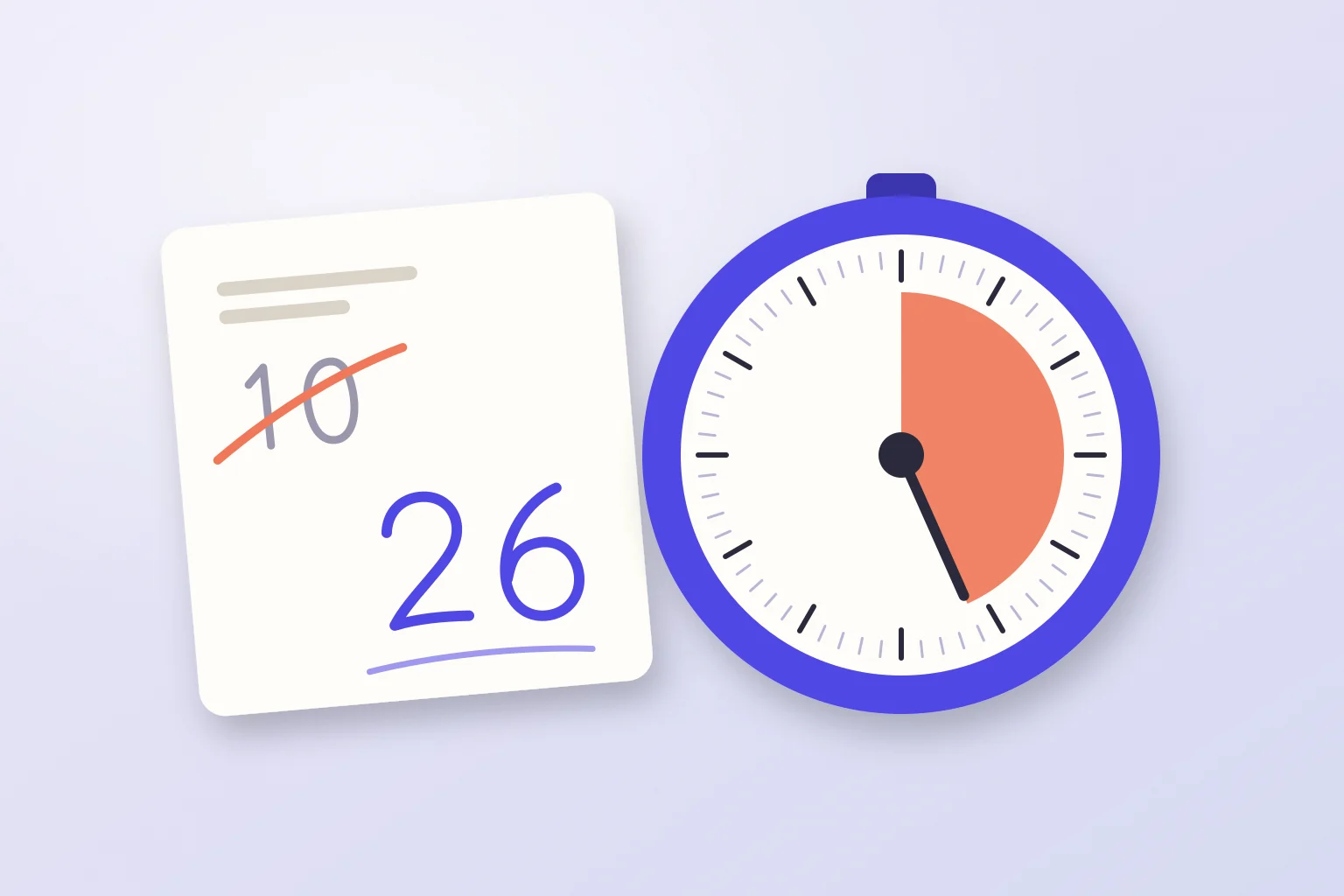
By Friday you'll have a short, mildly insulting list. Maybe you guessed 10 minutes to get out of the house and it took 26. Maybe the quick email is 18 minutes, every single time.
Divide real by guessed and you get a rough multiplier. Yours might be 1.5. It might be 3. From then on, when your head says twenty minutes, your calendar gets twenty times your number, and you don't argue with it. It has evidence and you have a feeling.
Unpack the task before you guess
“Make dinner” feels like 20 minutes. “Find a recipe, notice there are no onions, go to the shop, chop, cook, clean up” doesn't. In 2004, Kruger and Evans found that getting people to list a task's steps made their time estimates longer and more accurate.
You only need this for things you haven't timed yet, and thirty seconds of listing steps in your notes will do.
Work backwards from the door
Most of us plan forwards: I'll finish this, then get ready, then go. Forwards is how 3:52 happens. Start from the moment you have to be somewhere and walk back instead:
- •The appointment is at 4:00 and you want to be there by 3:50.
- •The map says 25 minutes. You know that route, so call it 30. Leave at 3:20.
- •Shoes, keys, looking for the keys, going back for your phone: your timed number is 12 minutes. Stop whatever you're doing at 3:08.
The only time worth remembering is 3:08. Put that one in your phone.
Set two alarms and give them names
One alarm gets dismissed. You'll tell yourself “yes, in a second”, and you'll mean it. So set one 15 minutes before your stop time, called “Wrap up, you're leaving soon”, and another at the stop time, called “Stand up. Shoes.” An alarm that says what to do next is harder to argue with than a beep.
While you're at it, put a clock somewhere you'd have to work to avoid seeing it. A big cheap one on the wall opposite your desk is enough.
The time nobody plans for: getting started
There’s a gap in most plans between “sit down” and “actually working”. You make a drink, open things, read what you wrote yesterday, check one message, find the file. People with ADHD sometimes call this start-up time, and it can run to 20 or 40 minutes every time you switch to something new.
Count it. For one week, note when you sat down and when you really began. Then put it in your plan as its own block: “9:00 to 9:30, getting going”. It looks like wasted time on the calendar, and it was already happening. Now it just isn’t making you late for everything after it.
The same goes for coming out of something. Getting your head out of a spreadsheet and into a meeting takes time, so a day of back-to-back switches loses much more than it looks like on paper. Where you can, group similar jobs together and give yourself fewer switches.
When you lose an afternoon to something interesting
The other side of time blindness is the hours that vanish because you’re absorbed: you sat down to fix one formula, and now it’s dark and you haven’t eaten. You can’t win this with willpower, since you won’t even know the argument is happening.
- •Set the alarm before you start, and leave the phone out of reach, so you have to stand up to turn it off. Standing up is half the job.
- •Say out loud what comes next. “At four I stop and pick up the kids” is harder to lose than a beep.
- •Ask someone to fetch you when something really can’t be missed. There’s no shame in a human alarm.
- •Keep a note beside you for “one more thing” ideas. Getting them out of your head makes it easier to stop.
Plan fewer hours than you have
Once you've got your multiplier, your to-do list will stop fitting into the day. It never fit. You've just got the numbers now.
If you have eight free hours, plan five and leave the rest empty. They won't stay empty. Something always spills over, and when it does it lands in space you left for it, so the rest of the day doesn't get shoved back.
Three people, three versions of 3:52
Ania and the school run
Ania has been late for school three mornings a week for two years, and both she and the school have views on this. She times it for a week. Getting her son out of the house takes 31 minutes, where she’s been allowing 15. So the first alarm goes at 7:50, labelled “Shoes and bags, now”, and the bags get packed the night before. They’re on time four days out of five. On the fifth it’s raining and nobody can find the other wellington, and she’s stopped treating that as a moral failure.
Chris and the one-hour job
Chris is a developer who quotes everything at “about an hour” and has never once been right. Clients aren’t pleased. So every estimate now gets written down next to the real time. After a month the multiplier is 2.6, and that’s the number that goes into every quote, with no discussion, even when this one looks easy. It feels like lying upwards. It’s also the first time in years that a client has been given a real date.
Lotte and the start-up time
Lotte has ADHD and works from home, and she used to plan her first task for 9:00. By 9:40 she was furious with herself, halfway through a second coffee. Now her calendar says “9:00 to 9:40, get going”, and what happens in that block is her business: coffee, the dog, tidying the desk. The plan starts at 9:40, and she’s usually early for it.
Questions people ask about time blindness
Is time blindness a symptom of ADHD?
It’s neither an official symptom nor a diagnostic term. It’s a popular name for something many people with ADHD describe, and the research above does find timing differences, though the adult evidence is thinner. You can also have trouble with time without having ADHD.
How do I stop being late all the time?
Time the real thing, once, and stop trusting your memory of it. Work backwards from the door, and set the alarm for the moment you have to stop what you’re doing, which comes well before the moment you have to leave. We’d start with those two changes.
What kind of clock or timer helps?
Anything you can see from where you work. A big wall clock costs very little. A visual timer, the kind with a coloured wedge that shrinks, shows time as an amount, which some people find easier than numbers. A kitchen timer on the far side of the room makes you get up.
What should I look for in an ADHD time management app?
Reminders you can name, and more than one per event. A timer next to your tasks. A way to see your day as blocks. And nothing that shames you for being late. Try it for a week on one real problem, like getting out of the door.
Comparing ADHD planner apps?
Eight side by side, ours included, with what each does badly.
Can time blindness get better?
Your internal sense of time may not change much, and we wouldn’t promise that it will. What changes is how often it costs you. Numbers, alarms and spare time do the job your gut was supposed to do.
Where DayriOS fits
You can do all of this with a notebook and a phone timer, and if that's working, carry on. We built DayriOS for people who'd rather not juggle separate tools. There's a focus timer next to your tasks and reminders on your phone and computer. On the free plan you get a morning summary with your top three tasks and one AI day plan a day. On Plus, which has a 7-day free trial, AI can break a task into two-minute steps and re-plan the rest of the day when you've fallen behind.
No app will give you a sense of time. It can only put better numbers and louder nudges around the one you've got.
Try it on the next thing you do today. Write down your guess, start a timer and see how far off you were.
Planning a whole day with ADHD
One Must, two Maybes, and events instead of clock times.