Your voice memos are a graveyard. Turn three minutes of rambling into a plan
Open your voice memos and scroll down a bit. “New Recording 47.” Forty seconds of you in a car park, saying something you were sure you'd need later. You've never played it back, and you never will.
Talking is a great way to get things out of your head and a terrible way to get them back. Nobody wants to sit through twelve minutes of themselves to find the one line about the dentist.
It's worth fixing anyway, because speaking is fast. A 2016 Stanford study measured speech at about three times the speed of typing on a phone: 153 words a minute against 52. And you can do it while you're walking the dog.
A three-minute script
A blank recording is intimidating, so don't start with one. Set a timer for three minutes and answer these out loud, in this order:
- 1.What's taking up space in my head right now? All of it, in any order, including the stupid stuff.
- 2.What am I dreading?
- 3.What actually has to happen in the next 24 hours?
- 4.If I only get one thing done tomorrow, which one?
You'll feel like an idiot for the first thirty seconds. Keep going past the point where you think you've finished, because the obvious stuff comes out first.
Sort it into three piles
What comes out will look something like this:
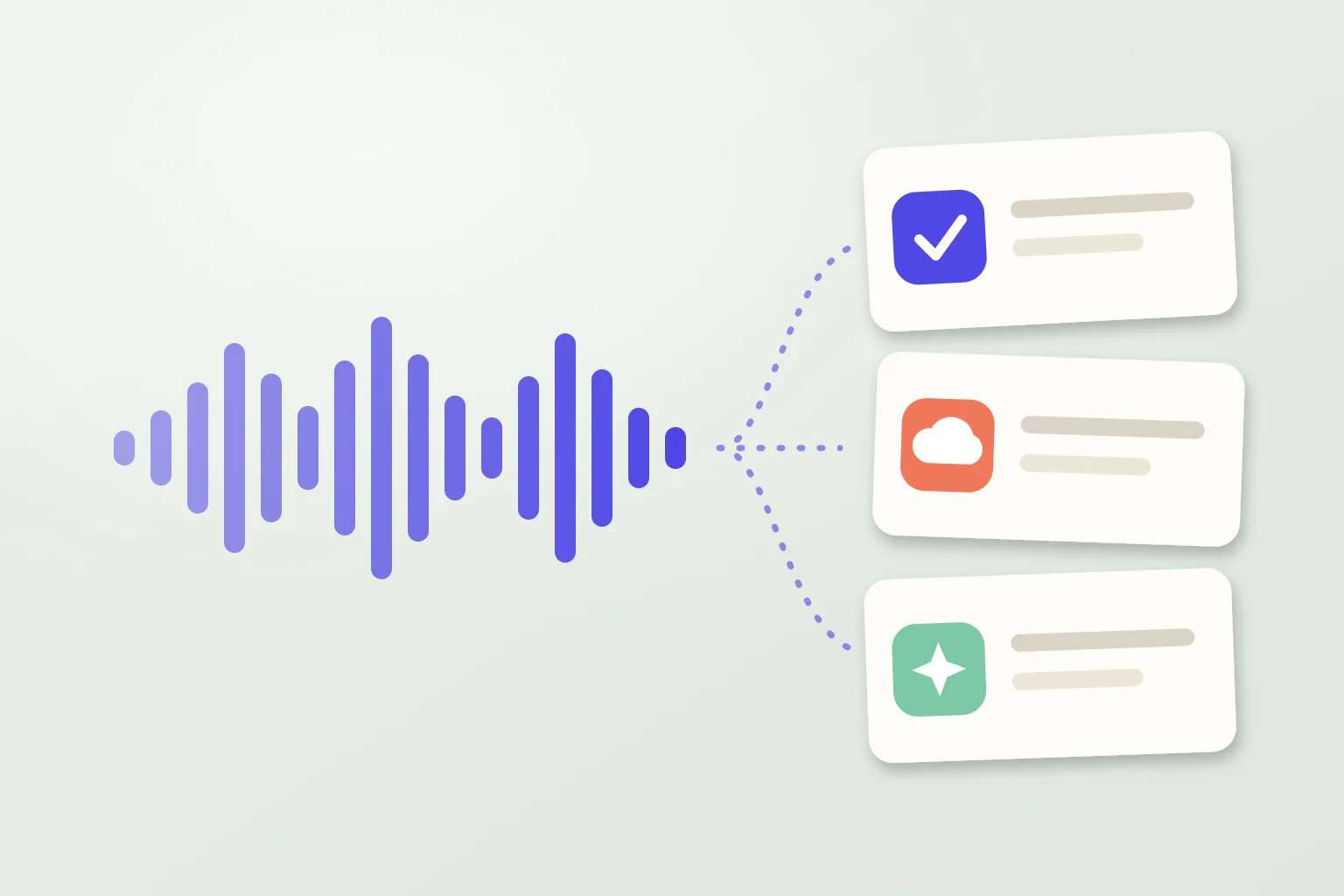
That one breath holds three different kinds of thing:
- •Tasks have a verb and you could do them. Call the dentist. Check when the car insurance is due.
- •Worries can't be ticked off. Anna and the Tuesday thing. Leave them off your to-do list, where they'd only sit and glare at you.
- •Ideas are interesting and not for today. The launch video goes somewhere you'll find it again.
The worries pile is the one that matters
For each worry, ask one question: is there anything I can do about this? If yes, it becomes a task. “Ask Anna if we're okay” takes a few seconds to write and possibly a whole day to work up to. If no, leave it in your journal and move on.
There's some science behind why this feels better. Masicampo and Baumeister found that a specific plan quietened intrusive thoughts about unfinished goals. In a 2007 brain-imaging study with 30 people, Lieberman and colleagues found that putting a feeling into words reduced the amygdala's response. These are small studies, so don't build a religion on them. They would explain why saying the thing out loud can take some of the air out of it.
One ramble, start to finish
Here’s an invented example. It’s Tuesday, 7:50 p.m., someone’s walking home from the bus, and this is what comes out after the transcription has done its worst:
That’s under a minute of talking. Sorted, it looks like this:
- •Tasks: email Tom for the numbers, check the date of Mum’s birthday and pick a present, book someone to look at the knee, book the car in.
- •Worries: tomorrow’s one-to-one, which gets a small task of its own (write down two things to say about the report), and the cake sale, which gets one too (tell them tonight that you can’t do it).
- •Ideas: another job. It isn’t a task yet. It goes somewhere safe, with a note to come back to it on Sunday.
Tomorrow’s one thing was said out loud at the end: email Tom. Five lines, a decision, and the walk home took the same time it would have taken anyway. This person has also just discovered they’ve been worried about their knee for a month, and that had never once made it onto a list.
Other scripts for other moments
The same trick works with different questions. Pick the one you need.
First thing in the morning
- •How did I sleep, and how much energy have I got?
- •What’s the one thing that would make today okay?
- •What’s the first step of that?
At the end of the day
- •What went okay today?
- •What’s still open that I don’t want to carry to bed?
- •What does tomorrow start with?
After a hard conversation
- •What happened, in one go, without tidying it?
- •What did I feel, and what am I afraid it means?
- •Is there anything I want to say or do next, or did I just need to say this?
When you’re trying to build a habit
- •Did I do it today? If not, what got in the way?
- •Where in the day did it fit, or not fit?
- •What would make it easier tomorrow?
That last one is a daily voice reflection in about a minute, and you can stop as soon as you have your answer. Nobody needs a ten-minute soliloquy.
The free way, on any phone
You don't need a special app for this, ours included.
- 1.Open your notes app and tap the microphone on your keyboard. Most phones have one.
- 2.Talk for three minutes. It'll mangle a few words, and that doesn't matter.
- 3.Spend five minutes moving lines under three headings with your thumb, or paste the text into a chatbot with this: “Sort this into tasks, worries and ideas. Don't add anything I didn't say.”
Before you paste anything personal into a chatbot, check whether it trains on your conversations.
Who this suits
Marek, site inspector: no free hands
Marek spends his days walking round buildings with a torch in one hand and a clipboard he hates in the other. He used to write it all up at the end of the day, from memory, with gaps. Now he talks into his phone as he goes: “Third floor, east stairwell, handrail loose, photograph it, tell Janek.” Each evening he sorts a dozen of those in ten minutes. Typing it on site was never going to happen.
Tess, three kids: nine years of meaning to keep a journal
What Tess has instead of journaling time is a pram, a dog and a twenty-minute walk. So she talks on the walk, with earphones in, looking as if she’s on a call. She doesn’t read most of it back. The point is that things stop going round her head, and the three tasks that fall out of it go into her list at the door.
Ravi: thinks faster than he types
Ravi’s written notes have always been a mess, and by the time he’s typed half a thought the second half has gone. At his desk he now speaks the first draft of anything difficult, an email to a client or the outline of a plan, and edits the transcript. Editing is easier than the blank page ever was.
It suits you less if you work in an open-plan office, or if hearing your own voice makes you want to leave the country. In the first case a quiet stairwell will do. In the second, you never have to listen to it. The transcript is what you read.
Where this stops working
A dump isn't a plan. You've still got to pick what happens tomorrow, which is what question four is for.
And if the same worry comes out every night for weeks, more journaling probably won't shift it. Take that one to a person you trust, or to a professional.
Questions people ask about voice journaling
What is a voice journal?
It’s a journal you speak instead of write. You record a few minutes about your day or what’s on your mind, and you either keep it as a transcript or sort it afterwards. It suits people who’ve never kept up a paper diary, because there’s nothing to sit down to.
How long should a voice journal entry be?
Three minutes is plenty. Anything much longer tends to go round in circles, and you’ll have more to sort afterwards. If you have more to say on a particular day, say it, and don’t make that the rule.
Can an app turn voice notes into tasks automatically?
Several can, and a free chatbot can do a rough version if you paste in the transcript. The thing to check is where the result ends up. Does it land in your task list with a date, or do you have to copy it over? And look at what each app does with your recordings.
Does a voice journal help build habits?
It’s no magic ingredient. It can help you notice what’s getting in the way, if you ask yourself the questions above. A short daily recording can also become a habit itself, if you tie it to something that already happens, such as walking to the bus.
Can I do it in my own language?
Yes. Phone keyboards dictate in many languages. Accents and mixed languages cause more mistakes, and that’s fine, since you only need to recognise what you meant.
Is it private?
That depends on where the recording goes. Before you send one to an online service, read what it does with it and whether it trains AI on your data. Ours doesn’t. Either way, think twice before recording things about other people that you wouldn’t want read out.
What DayriOS does with it
In DayriOS you hit record in the app, on your phone or PC, or send a voice note to the optional Telegram bot. Recording and transcription work on every plan, in 14 languages, and the audio stays privately with the note, so a bad transcription doesn't lose the thought. It does need a connection, and the free plan holds 10 notes.
The sorting is where the paid plan comes in. Mental Unload takes a ramble and hands you the three piles: tasks with priorities, worries with a calmer way of looking at them, and ideas. You get five a month on Plus, which has a 7-day free trial, and unlimited on Pro. Your recordings and notes are never used to train AI models.
It won't ring you up and ask how your day went, if that's what you were hoping for. You press record and it does the filing.
Next time you're walking somewhere on your own, try it with whatever's on your phone. Answer the first question and see how long you keep going.
Voice notes in DayriOS
Record in the app, in 14 languages, and keep the audio with the note.
Thoughts keeping you up at night?
A brain dump for racing thoughts, step by step.